A Brief History of Koichi Tohei and the Creation of Ki-Aikido
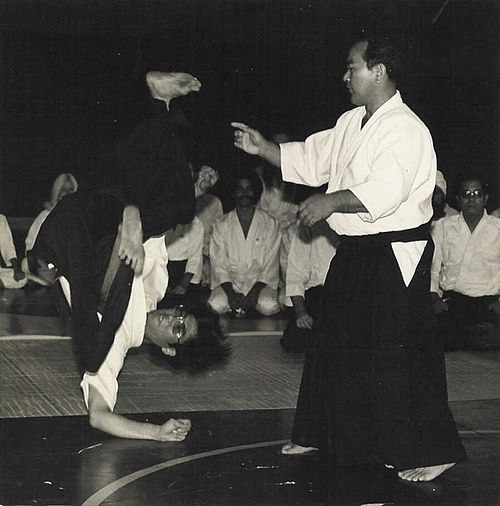
Koichi Tohei was born in January 1920. At the age of 9, he began training in judo. From the age of 17, he studied misogi and zen. At 19, he started practicing Aikido under Morihei Ueshiba. At 25, he began studying the principles of mind-body unification under Tempu Nakamura. He taught Ki principles and Aikido in the USA and Europe from 1953. In 1971, he founded the "Ki no Kenkyukai" (KI NO KENKYUKAI), where to this day the principles of becoming one with the Universe are taught, along with the ability to apply these principles in Kiatsu practice and in everyday life. On May 1, 1974, he founded "Shin Shin Toitsu Aikido," known outside Japan as "Ki-Aikido" — that is, Aikido based on the principles of mind-body unification and merging with the Universe.
K. Tohei, speaking about himself, always emphasized that he had devoted his entire life to metaphysical studies and intended to continue them until the end of his days, since the Universe is limitless — it has neither beginning nor end — and therefore we cannot rest on what has been achieved. The more we learn about a given field, the more we understand how much remains to be discovered. To enjoy life in all its fullness is the greatest pleasure.
K. Tohei began practicing judo at the age of nine. Despite being a sickly and frail boy from birth, the judo training strengthened his Ki and was successful — he won judo competitions among students. But one day, during training, he suffered a chest injury, and the doctor forbade him from practicing judo and physical exercises, limiting him to short walks. This turn of events completely crushed K. Tohei, and his Ki weakened.
What he experienced in those days taught him that a person may be physically ill, but his mind must never succumb to illness. The agonizing days spent in bed convinced him that one must not waste one's life in such a manner.
After two months, K. Tohei began to feel well enough to sit up. He started reading books on metaphysical training, meditation, and religion. He read the "Analects" of Confucius and "Mencius" — two ancient Chinese books — as well as biographies of many great people of this world. He was especially captivated by another ancient Chinese masterpiece — "Saikontan," which he reread so many times that he nearly memorized it. (According to uchi-deshi Kotoji Shigeru, K. Tohei read many treatises and books about zen masters and martial arts masters and often, during training at Hombu Dojo, quoted sayings of Miyamoto Musashi from "The Book of Five Rings," as well as sayings from other sources.)
Gradually, K. Tohei came to the decision to begin training himself, a resolve that was strengthened after reading the book "Conversations with the Master." This book was devoted to the life and philosophy of the Japanese martial arts master and statesman Yamaoka Tesshu. It described his steadfast adherence to ascetic practices. The description of training at the Shumpukan dojo made an especially powerful impression. Upon learning that the author of this book had trained at Ichikukai dojo, which was located not far from Tokyo, Koichi Tohei set off there.
At first, he was not accepted into the dojo because of his frail build and sickly appearance. But K. Tohei insisted on his desire to train at the dojo, and they offered him to practice zazen first, and then, once he grew stronger, to move on to the meditative practice of misogi.
The zazen sitting began at 6 o'clock in the evening. From 7 to 8 o'clock, master Josei Ota gave lectures. After half a year of practice, K. Tohei restored his health and the strength of his Ki. He could spend the entire night in zazen. Soon he was admitted to misogi — a breathing method that had been developed by Shinto religious practitioners. This method consists of everyone chanting sounds in unison with the ringing of bells. In particular, eight syllables were chanted: "To-Ho-Ka-Mi-E-Mi-Ta-Mi." (This practice is still used today at K. Tohei's Hombu Dojo. During the chanting, a bell is taken in the right hand, raised up and sharply brought down to the right knee, as if it were a sword, in rhythm with the exhalation and the sound.) This practice effectively strengthens the mind and body and does not allow one's Ki to weaken.
On the very first evening after misogi, K. Tohei developed chest pain similar to the pain he had experienced when he fell ill with pleurisy. But he did not abandon his practice, because he had given himself his word not to stop, even if it killed him. "That's fine," he thought. "If I am destined to die, then let me die." Having made peace with this thought, he continued to train, and the pain gradually began to subside, and after three days it ceased entirely.
After some time, K. Tohei became the senior student and helped beginners improve. Sitting in zazen all night, K. Tohei would go to school and constantly fall asleep during classes. And since he sat motionless and maintained good posture while doing so, his classmates nicknamed him "Tenjo Yuiga Dokusan," which means "I am the center of the Universe" — a well-known Buddhist saying.
Approximately a year later, K. Tohei quit judo, because after practicing zen and misogi, it no longer brought him satisfaction. Judo techniques were based solely on body movement and ignored the movements of the mind. K. Tohei's judo club instructor gave him a letter of recommendation to the master of Aiki-budo, Morihei Ueshiba.
At the time of his arrival at the Ueshiba dojo, the master was absent, so K. Tohei asked a student of Morihei Ueshiba what Aikido was. The student took K. Tohei's hand and applied a painful grip. It was very painful, but he endured it while continuing to look the student in the face. (Once upon a time, long ago, a samurai traveled to Korea to fight a tiger. The samurai let the tiger gnaw on one hand, and with the other hand drew his sword and killed the tiger.) Seeing K. Tohei's reaction, the student stopped. K. Tohei was disappointed and was about to leave, but at that moment Morihei Ueshiba returned and, with his student, demonstrated throws that from the outside appeared to be fake. Master Ueshiba invited K. Tohei to attack him. K. Tohei tried to grab him but instantly found himself on the tatami. He could not understand how the master had managed to throw him. He did not feel that any force had been applied to his body. If force had been applied, one could have thought about defense, but he felt no force whatsoever. K. Tohei understood that this was what he had been searching for.
K. Tohei was fortunate — he was accepted as a student. And after just 6 months, no one in the dojo, with the exception of Master Ueshiba, could throw him in the kokyu-dosa technique, which is performed in seiza.
Later, K. Tohei understood the reason. Without realizing it himself, he had been observing the first and third of the Four Basic Principles of mind-body unification: keep attention at the One Point and relax completely. He had been doing this thanks to his developed practice of zen and misogi, since it is impossible to sit in zazen all night with tense arms and shoulders, or to perform misogi all day. In order to practice these for a long time, one must relax completely. Thus, K. Tohei came to Morihei Ueshiba's dojo already possessing the ability to unify mind and body, which is why he quickly began to master the art of Aikido.
Already within a year of starting his training, K. Tohei began accompanying Morihei Ueshiba and sometimes conducting classes in his place. At that time, K. Tohei held a black belt in judo but had no rank whatsoever in Aiki-budo, even though he was teaching people there.
During his spiritual practice, K. Tohei had solved many koans and thought he was prepared for death. However, participating in combat operations in 1944 on Chinese territory showed the difference between everyday life and real battle. Koichi Tohei felt bitter shame for the fear he experienced during the fighting. He realized he was not ready for death and began sitting for long periods in zazen, reasoning as follows: "If the Universe possesses intelligence, it will not allow all my training to have been in vain. It is too early for me to die, because I have not managed to finish what I started. If I must die now, then the Universe lacks intelligence, and I do not want to deal with such a Universe. I will gladly leave it. I will gladly submit to the Universe's decision about whether I should live or die." After reaching this resolution, K. Tohei felt a great lightness and unburdening in his soul. This was a state of true relaxation — the second of the Four Principles of mind-body unification. After that, bullets no longer troubled him. He began to understand that if one trusts the Universe and relaxes completely, it fills one with fresh Ki, and then even bullets do not touch such a person.
Thus, K. Tohei became firmly convinced that by relaxing completely and filling oneself with Ki, one can cope with all of life's difficulties.
During intense frontline situations, K. Tohei would place his strength in the lower part of his abdomen, and often, in doing so, would begin to feel weakness. But if he forgot about this point, fear would grip him. This paradox troubled his mind and compelled him to investigate. As a result, it became clear that the lower abdomen is not a place where one should direct one's strength. Mere concentration of the mind on it is enough — and strength comes to the right place in the body on its own. Thus, K. Tohei came to the conclusion that the truly effective method in any situation is one — to focus one's attention at the One Point below the navel.
After this, K. Tohei felt at ease, could relax completely, and maintained the ability to manage any intense and difficult situation.
After the war ended, K. Tohei resumed his misogi and Aikido training, and soon received his sixth dan. In 1952, Master Ueshiba awarded him the eighth dan, and four years later — the ninth, and appointed him chief instructor at Aikido headquarters.
By that time, Morihei Ueshiba's technique had reached perfection. No one could understand where the fluidity of his movements came from. Using the same technique, his students could not overcome an opponent.
K. Tohei was introduced to Master Tempu Nakamura, who taught mind-body unification at the Gokokuji temple in Tokyo. Master Nakamura had practiced yoga in the Himalayas, and upon returning to Japan began to teach about the enormous power that a person possesses, and about how the mind moves the body. At these lectures, K. Tohei understood that Morihei Ueshiba first influenced the attacker's mind, and then threw his body, so that the attacker could not resist. Meanwhile, his students tried to move the body directly, without first using the mind, which is why their throws did not succeed.
But how can one control another person's mind? Before influencing someone else's mind, one must first learn to control one's own! After such reasoning, K. Tohei came to the conclusion that the foundation of Aikido is the unification of mind and body.
Aikido is essentially a path to becoming one with Ki. But if one regards this art as a means of merging with the Ki of other people, then this would be an incorrect understanding of the essence of Aikido, and in that case its methods become ineffective. Aikido should become the path of unification with the Ki of the Universe. And in order to become one with the Universe, one must first of all harmonize mind and body. Otherwise, if mind and body are separated, how can one become the entire Universe? True Aikido is based on the unification of mind and body.
Having thought over and reexamined the entire technique of Aikido in light of the rules of mind-body unification, K. Tohei realized that previously he had been using only physical strength, but after he learned to influence the opponent's Ki, he could easily throw a large person without applying force.
K. Tohei was a man of short stature, yet he taught Aikido in the USA and Europe to people who were twice his size, and he could handle four or five attackers at once. With physical strength alone, this would have been impossible. Therefore, K. Tohei always told his students:
"Before you learn to properly use Aikido technique, you must learn to unify mind and body. This is the path of Ki development. The main goal of training is correct Aikido technique, and mind-body unification is the means of achieving it."
While Master Morihei Ueshiba was alive, Ki was constantly spoken about. But after his death, people not only stopped thinking about Ki, but even tried to avoid the word altogether. As a result, Morihei Ueshiba's Aikido began to turn into mere formal technique.
Striving to preserve and develop the knowledge of mind-body unification, K. Tohei made the decision to leave Aikido Aikikai and founded the independent organization Shin Shin Toitsu Aikido Kai for the dissemination of Ki-Aikido — Aikido based on the principle of mind-body unification.
K. Tohei passed away on May 19, 2011 at the age of 91. His son, Shinichi Tohei, continued the path of his father, heading the international organization Shin Shin Toitsu Aikido Kai.
Today, Ki-Aikido is practiced by 30,000 people in Japan and more than 100,000 people worldwide.
This material is used with gratitude to the website of the Russian United Ki-Aikido Federation (ki-aikido.ru).
Experience the Legacy of Koichi Tohei
The principles Tohei Sensei devoted his life to developing — mind-body unification, extending Ki, complete relaxation — are taught today at our dojo in Haifa. Your first trial class is free.
Sign Up for a Free Trial Class